by LeJzae Davidson
 While there are many news sites to get your local news, sports news, entertainment news and so much more, there are even more sites that provide the nation with disinformation, also known as, “fake news.” What is fake news? Fake news is a new term that has come up in politics. Its defined as, “news articles that are intentionally and verifiably false” [1] designed to manipulate people’s perceptions of real facts, events, and statements. It’s about information presented as news that is known by its promoter to be false based on facts that are demonstrably incorrect, or statements or events that verifiably did not happen.” According to “A Citizens Guide to Fake News,” fake news comes through a complex of commercial, political, psychological, social, and computer-scientific factors that make it hard to grasp in its totality. And the topic has been politicized—individuals use the term, “fake news,” to undermine reporting that’s damaging to their own version of events.
It has not always been a thing though. Fake News recently became a trend especially within the recent elections. Since Donald Trump has been in office, it has certainly grown into citizens vocabulary. While it has become one of his favorite phrases, it was also categorized as “2017’s word of the year.”
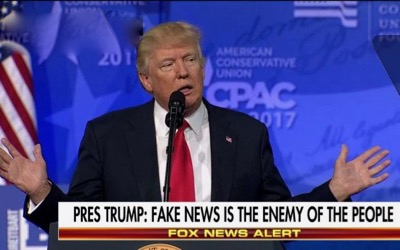
To add to that, fake news has become a problem to social media platforms as well:
Facebook says it has uncovered a coordinated disinformation operation ahead of the 2018 midterm elections.
The Washington Post and several other news organizations reported on July 31, 2018, that
“Facebook has shut down a sophisticated disinformation operation on its platform that engaged in divisive messaging…that could affect the November election. It also…questions whether other technology companies are still being used as conduits for disinformation, as Google, Twitter and others were around the last election.”
Fake news has changed the perception of political news on a negative spectrum. But according to CITS.edu, there is a way to point out and stay away from disinformation through politics. Factitious is game that is intended to help citizens identify fake news.
How else can you keep up with fake news? Here are a few websites:
- What is Fake News
- A Brief History of Fake News
- Where Does Fake News Come From?
- The Danger of Fake News in Inflaming or Suppressing Social Conflict
- The Danger of Fake News to Our Election
- How is Fake News Spread? Bots, People like You, Trolls, and Microtargeting
- Why We Fall for Fake News
- Protecting Ourselves from Fake News: Fact-Checkers and their Limitations
- Protecting Ourselves from Fake News: Games that Teach about Fake News
 Politics in Mass Media
This post was very informative about the definitions and origins of the term “fake news”. I also really liked how you listed sources at the end of the post for readers to do more research into fake news. I think it would have strengthened your arguments to have gone into more detail about the connection between Donald Trump and fake news, and maybe have given some examples of how Trump has used the term in important/ well known situations. Also don’t forget to create a byline on your posts!
LikeLike
This post was interesting, and I really felt like I got a full definition of “Fake News” by the end of the post. While the post was very factual, it might have been interesting to add some of your own opinions or more of a story. It would be helpful if you fleshed out more of a narrative about fake news, whether that be about Trump, or anyone else. Also, since your subcategory is on “news sites”, it would have been effective to focus in more and make clearer a specific new site. Additionally, a byline and sources at the end of your post are both essential for Dr. Kwami’s rubric! Altogether, this was a relevant and informative piece.
LikeLike
Okay! Gotcha. Thanks!
LikeLike